


Blue Shade of Online Bought 'Colloidal' Silver Solution
The description of the colloidal silver solution I bought mentions the following:
"This product is made of 100% colloidal silver with a concentration of 40 ppm. Thanks to the excellent manufacturing process, ionic silver is excluded."
However, the liquid has a blueish color, not orange like I would expect after going through some articles on this website.
Is this still safe for use?
Does it automatically mean it's actually ionic silver, or can pure colloidal silver also turn blueish when some impurities have occured in the process?
The taste is more metallic than neutral btw.
California
03/04/2026
Hi crxol,
I have never seen colloidal silver that is blue. Also a metallic taste would be common with ionic silver. Colloidal silver nanoparticles taste like water or tasteless. I looked for "Blue Shade" colloidal silver online to see if it gives a good description of what it is, but was not  able to find it.
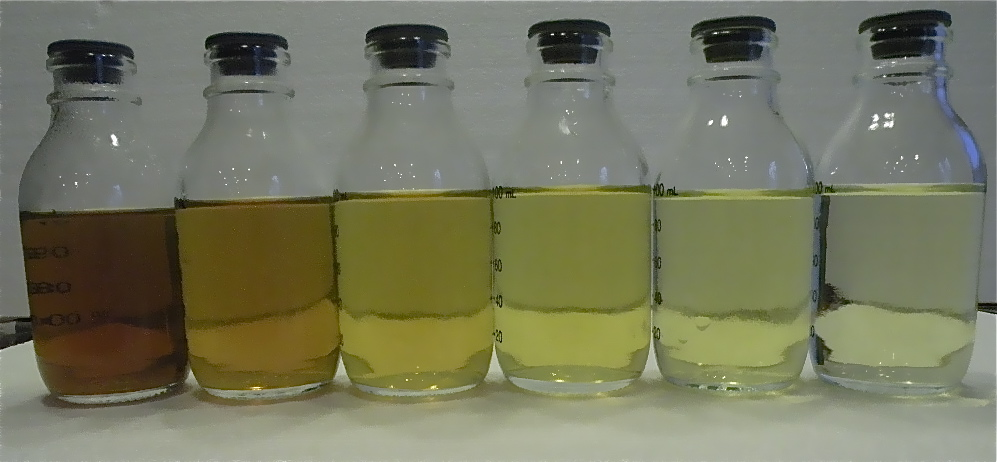
Colloidal silver nanoparticles at 40 ppm should be a darker yellow color, not bluish.
Here is an image showing 80 ppm on the right and reducing by half for the next bottle and so on. So in the following image the first bottle on the left is 80 ppm followed by 40 ppm, 20 ppm, 10 ppm, 5 ppm and the last bottle on the right is 2.5 ppm :
Art
Belgium
03/05/2026
Thank you, those are clearly different colors yes. I'm so confused by the topic, because at the same time I find online that ionic solutions wouldn't be able to reflect color, so that it's more likely to be an atomic solution. And a youtube video is showing a similar color for a colloidal solution that has oxidated or contains impurities: https://youtu.be/TLi6iLlLfiE
At the same time it's not clear from that video if it's ionic or atomic, as he's showing colorless ánd yellowish ánd bluish solutions...
California
03/05/2026
Hi crxol,
Yes, properly made ionic silver should be colorless with high clarity similar to distilled water, and have a slightly metallic taste. Silver nanoparticles (AgNPs) will vary in color from extremely light yellow to very dark brown like black coffee depending on ppm and have high clarity/low turbidity. Once it goes above 100 ppm it starts turning brown. Surface plasmon resonance is why AgNPs show color.
The great majority of products sold on Amazon are ionic silver.
The term "atomic silver" can sometimes be used as a marketing term for AgNPs.
I asked Google what it means if AgNPs appear bluish in color and it said this :
' Bluish, blue-violet, or grayish-blue appearances in silver nanoparticles (AgNPs) generally indicate that the particles are no longer small, stable spheres (which typically appear yellow or brown). Instead, a blue color signifies that the nanoparticles have either aggregated into larger structures or possess specific, non-spherical shapes, such as triangular nanoprisms. '
None of my batches have ever come out blue or violet in color and based on what Google said, I am glad that none of my batches ever did.
Given that information, I would not use the bluish solution that you have.
AgNPs are in a nano particle size range from 1 to 100 nm. Above 100 nm, they are no longer considered nanoparticles. Generally, the smaller the particles the more potent the antimicrobial effects of the suspension, but there is a sweet spot in the 12 to 20 nm range where the AgNPs will offer very good antimicrobial properties while still being less toxic to normal cells. Below 12 nm, AgNPs show increased effectiveness as an antimicrobial, but also increased toxicity to normal cells. Above 20 nm the potent antimicrobial effects start to decline significantly.
Art
